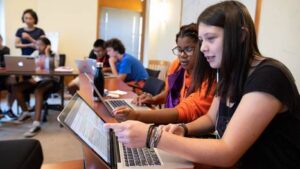
Artificial intelligence (AI) is increasingly being used in college classrooms today and is having a significant impact in several interesting ways:
Personalized Learning: AI can be used to develop personalized learning algorithms for students, providing tailored instructions and feedback to help students learn at their own pace.
-
Data Analytics and Predictive Modelling: AI and data analytics technologies can analyze large amounts of student data, identifying patterns, and behaviors, that can help predict student performance and needs, improving the overall quality of the academic experience.
-
Intelligent Tutoring Systems: AI can simulate one-on-one tutoring, providing instant feedback, answering student questions, and providing personalized study recommendations.
-
Automated Grading: AI technology can grade assignments, reducing the workload on professors and allowing them to dedicate more attention to instruction, mentoring and promoting research.
-
Better Resource Allocation: AI-informed resource allocation in classrooms is possible, prioritizing equipment and resources to achieve the highest potential for student learning outcomes.
-
Assistance in Research and Data Analysis: AI can assist researchers and students in complex data analysis, leading to new discovery and generating new business insights.
Overall, AI technology has the potential to significantly transform the college classroom, making it more personalized, productive, accessible, and inclusive for everyone involved.
However, the implementation of AI must be approached carefully, in a holistic, comprehensive, and beneficially ethical manner. Instructors and educational stakeholders must also ensure proper guidelines and privacy frameworks are in place to protect student data and privacy while leveraging the potential of AI.
For more details about this topic, see 43 Examples of Artificial Intelligence in Education.
To teach your students about artificial intelligence and intelligent technologies, check out Excellence in Business or Business Communication Today at https://lnkd.in/bvxGGmT.
Read more
 "Long emails and dense, difficult to decipher memos mean modern office communication goes ignored more often than it’s understood. For over a decade, I taught college students how to communicate in professional settings. Every class began with a single, all-consuming thesis: “Nobody will ever want to read anything you write at work. Period.”




 "Are you open about the areas where you want help? Respectful of your mentor’s time and advice? Here are the characteristics that can make you someone whom other people would like to guide, from mentoring researcher Victoria Black."
 "Leave stage fright, jitters, and nerves behind by developing key performance hacks as told by Juilliard performance psychologist Dr. Noa Kageyama."